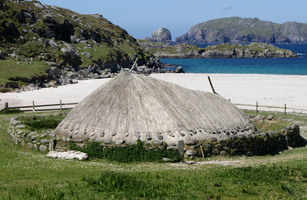
Also known as 'jelly-bean' or 'figure-of-eight' roundhouses, conjoined roundhouses are a single structure composed of two circular cells butted up to each other, which sometimes share a connecting doorway. One cell is usually smaller than the other and these may have been used as store-rooms. Such roundhouses were to be found right across Britain and Ireland during the Iron age. On the island of Great Bernera in the Western Isles, Scotland, conjoined roundhouses were found on Bosta beach dating to the 1st millennium AD. These were semi-subterranean. The image is of the reconstruction at Bosta beach.
The National History Museum, St. Fagans, in Cardiff, Wales, is building its own conjoined roundhouse based on excavations in Bryn Eryr, Anglesey. The excavated walls were 2.1m thick and made of clay. There is some debate regarding how best to roof such a structure. Some suggest roofing each house individually and merging the thatch where they meet, while others suggest that building a single roof that covers both cells would avoid any awkward unions.
The National History Museum, St. Fagans, in Cardiff, Wales, is building its own conjoined roundhouse based on excavations in Bryn Eryr, Anglesey. The excavated walls were 2.1m thick and made of clay. There is some debate regarding how best to roof such a structure. Some suggest roofing each house individually and merging the thatch where they meet, while others suggest that building a single roof that covers both cells would avoid any awkward unions.
 RSS Feed